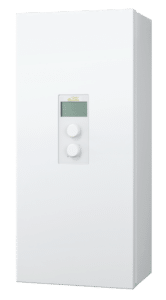




Why Not an Electric Boiler?
Electric boilers are often pitched as the “simple swap” for a gas boiler – same wet central heating system, same radiators, just running on electricity instead of gas. On the surface, that simplicity is appealing. In practice, we find electric boilers create as many problems as they solve for most of our customers.
Running costs can be steep. Electric boilers convert electricity directly into heat at close to 100% efficiency, but electricity in the UK costs considerably more per kWh than gas has historically done, and that gap doesn’t disappear just because the appliance itself is efficient. Unlike a heat pump, which can deliver more than one unit of heat for every unit of electricity consumed, an electric boiler delivers, at best, one unit of heat per unit of electricity. For anyone heating a full house through a cold Cotswold winter, that can mean a noticeably higher bill than the alternatives.
Your incoming electrical supply can easily be a constraint when considering an electric boiler. A lot of older properties (and smaller properties such as small cottages or flats) usually have a lower rating on the main incoming fuse – often limited to just 60 Amps. A 14.4kW electric boiler requires a dedicated 63 Amp supply just for itself!
Unless you have a separate hot water cylinder (or Sunamp heat battery), an electric boiler operating on a 63 Amp supply is not suitable for homes with a bath. The flow rate of the water is also incredibly low and whilst it will work best with a shower only, the flow rate hardly makes for an invigorating shower.
You still need a wet system. Electric boilers heat water that’s then pumped around your existing radiator and pipework network, just like a gas boiler does. That means all the same limitations apply; pipework needs to be in good condition, radiators need to be correctly sized, and if you’re doing a full retrofit into a property that never had wet central heating, you’re looking at the same disruptive first-fix work including lifting carpets and floors, chasing walls, running pipework that would be required for any other wet heating system. There’s no getting around that upheaval simply because the source of heat has changed from gas to electric.
No thermal storage, no flexibility with tariffs. An electric boiler generates heat on demand, which means it draws electricity exactly when you need warmth – often during the more expensive peak periods of the day. It can’t easily take advantage of cheaper overnight electricity tariffs the way a system with built-in thermal storage can, so you end up paying peak-rate prices for a resource you could, in principle, buy much more cheaply.
Again, electric boilers absolutely have their place and can work for smaller properties (assuming the main fuse is large enough), flats, or as a straightforward like-for-like replacement where a wet system already exists and running costs are a secondary concern. But for most of the homes we work on, we think our customers can do better.
The Case for radTherm® Electric Radiators
This is where radTherm® earns its place as our default recommendation for room-by-room electric heating.
- Minimal disruption, maximum flexibility. RadTherm® radiators are ceramic core, self-contained units that mount straight onto a wall and plug or hard-wire into the electrical supply. There’s no pipework, no plant room, no wet system to install or maintain. For a period property where lifting floorboards or chasing out stone walls is either impractical or something the homeowner simply doesn’t want to do, this is transformative. We can typically fit a whole-house system in a fraction of the time a wet system would take, with far less mess and disturbance to the fabric of the building.
- Room-by-room control. Because each radTherm® radiator is independently controlled, every room can be heated to exactly the temperature that room needs, exactly when it’s needed. A guest bedroom that’s rarely used doesn’t need to be heated to the same schedule as the kitchen or living room. This zoned approach avoids the “all or nothing” inefficiency of a central wet system, where you’re often heating the whole house to warm the one room you’re actually using.
- Reactive thermal mass for steady, comfortable heat. RadTherm® radiators use a patented ceramic smart core with high thermal mass, meaning they store heat and release it gradually and evenly, rather than the sharp on-off cycling and uneven heat you get from some cheaper panel heaters. The result is a background warmth that feels closer to a traditional radiator system than people typically expect from electric heating.
- No servicing, no safety certificates, no ongoing maintenance costs. There’s no combustion happening anywhere in the building, no flue to maintain, and no annual boiler service required. For homeowners tired of the recurring cost and hassle of servicing a gas or oil boiler, this is a genuine, ongoing saving – both in money and in mental load.
- Suitability for listed and conservation properties. Because there’s no external unit, no flue, and minimal fixing required, radTherm® installations are far less likely to run into planning or conservation objections than other technologies.
The Case for Sunamp Heat Batteries In Conjunction With radTherm® Radiators
Hot water is a separate challenge from space heating, and it’s one that too many “whole system” conversations skate over. This is where Sunamp heat batteries come in.
A genuinely different way of storing energy. Rather than storing hot water in a traditional cylinder – which loses heat over time and takes up considerable space, Sunamp heat batteries use phase change material to store thermal energy far more densely and with much lower standing losses. A Sunamp unit can be significantly smaller than an equivalent hot water cylinder, which matters a great deal in properties where airing cupboards and plant space are often at a premium.
- Compatibility with cheap, off-peak electricity. A Sunamp heat battery can be charged overnight using a cheaper electricity tariff, storing that energy ready to deliver hot water on demand throughout the day. This is one of the most compelling arguments in favour of the radTherm®/Sunamp combination: it allows homeowners to shift the bulk of their electricity use to off-peak hours, meaningfully reducing running costs compared with a system such as an electric boiler – that draws power on demand at whatever the prevailing rate happens to be.
- Instant, mains-pressure hot water on demand. Unlike a traditional cylinder, which can run out of stored hot water after a couple of showers, a Sunamp heat battery delivers hot water via a heat exchanger at mains pressure, essentially on demand, for as long as the stored energy lasts – which is comfortably enough for daily use.
- A natural partner for renewables. For customers who have, or are considering, solar PV, a Sunamp heat battery is an excellent way to make use of surplus daytime generation, storing that “free” energy as hot water rather than exporting it back to the grid for a fraction of its value.
- Compact and flexible installation. Because Sunamp units are so much smaller than an equivalent hot water cylinder, they open up airing cupboard space that would otherwise be lost, which is often a real practical win in smaller homes where every cupboard counts.
Bringing It All Together
What we like about the radTherm® and Sunamp combination isn’t any single feature in isolation – it’s how well the two technologies complement each other, and how well that pairing suits the properties we actually work on. Together, they offer:
- Low-disruption installation, ideal for listed buildings, conservation areas, and homes where residents don’t want weeks or months of building work
- Room-by-room control for space heating, avoiding the inefficiency of heating a whole house uniformly.
- Compact, efficient hot water solution that frees up space and delivers water on demand.
- The ability to take advantage of cheap, off-peak electricity tariffs for both space heating and hot water, keeping running costs in check.
- No flues, no combustion, no annual servicing, market-leading warranties and far fewer planning hurdles than the alternatives.
- A system that scales sensibly, whether you’re heating a two-bedroom cottage or a larger converted barn
We’re not against electric boilers as a technology – in the right home, they can be excellent choices, and we’ll always give you an honest assessment of what will genuinely work best for your property. But for the majority of the homes, cottages, and characterful properties we’re called out to across the Cotswolds, radTherm® electric radiators and Sunamp heat batteries consistently deliver the best combination of low disruption, controllable running costs, and long-term reliability.
If you’d like to talk through what would work best for your home, get in touch with Cotswold Heating Solutions Ltd. We’re always happy to visit, take a proper look at your property, and give you a straightforward, honest recommendation – not just a sales pitch.