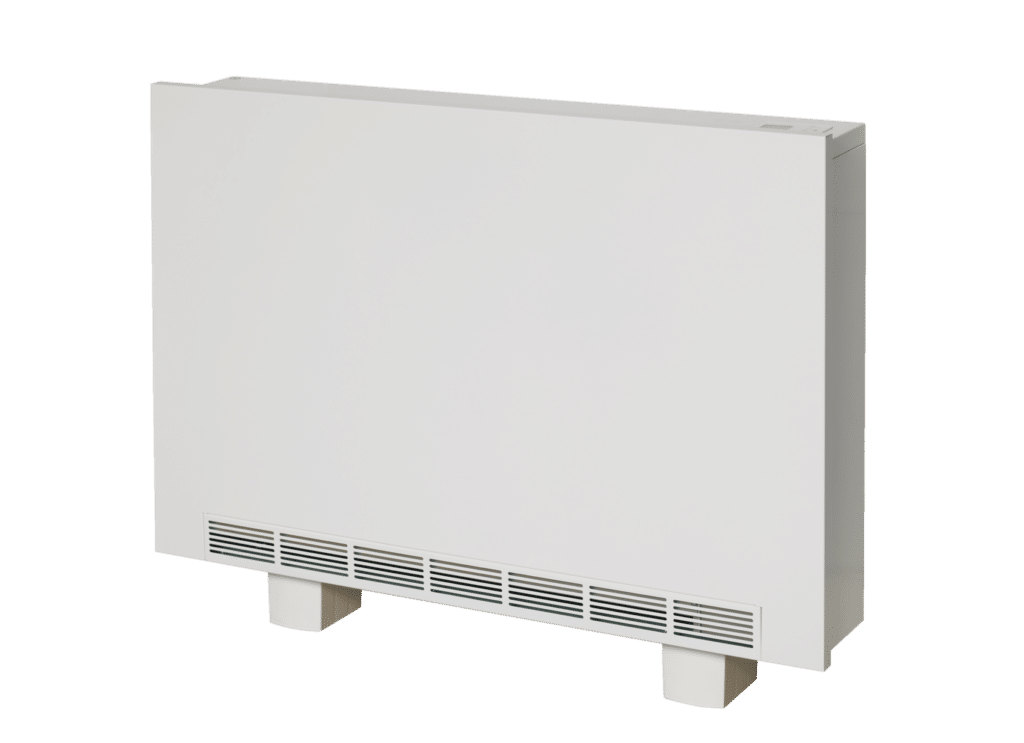




Anyone comparing electric heating options seriously will, sooner or later, come across two technologies that sit in a slightly different category from ordinary panel heaters or aluminium radiators: radTherm® partial storage radiators, which we install, and our HHR (High Heat Retention) storage heaters. Both are built around the same core idea – storing heat in a dense material and releasing it gradually, rather than generating warmth purely on demand – but they arrive at that idea from genuinely different directions, and they behave quite differently in a real home.
We also get asked a lot about how each technology affects a property’s EPC rating, particularly by landlords. It’s a fair question, and one with a more nuanced answer than generic marketing tends to let on. We want to lay out both technologies honestly, including where the EPC maths genuinely favours one over the other, so you can make a properly informed decision rather than relying on brochure claims alone.
How radTherm® Partial Storage Radiators Work
RadTherm® radiators are built around a high-grade steel body housing a patented dense ceramic “smart core.” When the radiator calls for heat, the element embedded in the core heats up, and the core itself absorbs and retains a meaningful proportion of that energy, enough that once the target temperature is reached and the thermostat interrupts the power, the radiator can continue releasing stored warmth for a period of around one hour with no further electricity draw at all, before topping itself back up with only a brief burst of power as needed.
This is genuinely “partial” storage: rather than being charged once overnight and running down through the day like a traditional storage heater, radTherm® radiators trickle-charge themselves on demand throughout the day, drawing power only for short bursts to maintain the core’s temperature. Each radiator is individually thermostatically controlled, so every room can be run to its own schedule and temperature, and because the core doesn’t rely on a single fixed overnight charge window the system isn’t tied to an Economy 7 tariff to deliver its efficiency benefits, though it can still be scheduled to take advantage of cheaper off-peak rates where they’re available.
How HHR Storage Heaters Work
The HHR is a more traditional storage heater in its underlying architecture, brought up to date with modern controls. It uses a dense ceramic block core, charged overnight during a defined off-peak window. However, the unit is specifically designed around an Economy 7 or Economy 10 tariff, and needs a dual-rate smart meter to operate as intended. Rather than trickle-charging through the day as radTherm® does, the HHR takes its charge overnight, based on an algorithm that predicts how much heat will actually be needed the following day, and then releases that stored heat gradually via a fan-assisted system, topping up with a small amount of direct-acting boost element if extra warmth is needed.
Where the HHR meaningfully improves on traditional old-style storage heaters is in its “high heat retention” design: significantly better insulation around the core than older units, plus smart controls that includes features like open-window detection, geolocation-based setback, and app control. It’s a considerable step up from the storage heaters we discussed in an earlier article on this subject, and it’s worth being clear about that.
The EPC Question: Where the Two Technologies Genuinely Diverge
This is the part of the comparison most manufacturers gloss over, and it’s worth understanding properly, because it isn’t just marketing spin – it comes down to how the government’s own assessment methodology actually works currently.
EPC ratings are generated using the Standard Assessment Procedure (SAP), or its simplified version for existing homes, RdSAP. Within that methodology, there’s a specific, formally defined technology category called High Heat Retention Storage Heaters (HHRSH). To be listed in this category on the government’s Product Characteristics Database (PCDB) which the database SAP assessors are required to use, a manufacturer has to submit test evidence to the Building Research Establishment (BRE) demonstrating the unit is capable of at least 45% heat retention, tested to the relevant British Standard. Once a product is listed under this category, an assessor can select it specifically, and the software applies the more favourable cost and efficiency assumptions associated with genuine off-peak storage heating.
The HHR Storage Heaters we recommend and install are recognised on the BRE’s SAP product database under this HHRSH category. That recognition matters in practice: several independent sources report that swapping standard electric panel heaters for a listed HHR storage heater can improve an EPC score by a meaningful number of SAP points, and the manufacturer of our HHR claim running costs up to 40% lower than standard electric radiators and up to 20% lower than older, non-HHR storage heaters.
Here’s the important nuance: the HHRSH category in SAP is narrowly defined around the classic overnight-charge, fan-assisted storage heater architecture. Partial storage radiators like radTherm® work on a genuinely different principle, trickle-charging through the day rather than a single overnight charge and currently products of this type generally sit outside that specific HHRSH classification. Where an electric radiator isn’t listed under the HHRSH category in the PCDB, RdSAP has little choice but to assess it under the more conservative “direct-acting electric heater” methodology, which doesn’t give true credit for the genuine thermal storage and reduced electricity consumption that a product like radTherm® delivers in the real world. This is a well-recognised limitation of the current SAP methodology – it wasn’t designed with modern partial-storage electric radiators in mind, and the assessment software simply can’t award it credit for behaviour outside the boxes it’s built to check (a tick box exercise).
In practical terms: if your priority is maximising a paper EPC score, particularly as a landlord working toward a minimum required rating, a formally HHRSH-listed product like the HHR currently has a structural advantage in the assessment software, regardless of how well any given partial-storage radiator performs in reality. That’s a fair point in the HHR’s favour, and not one we want to gloss over.
The Case for the HHR Storage Heater
Given the above, there are genuine situations where the HHR is the more sensible specification:
- Rental properties chasing a specific EPC banding. Where a landlord needs to hit a minimum EPC rating and every SAP point counts, the formal HHRSH recognition can make a measurable, documented difference to the assessment outcome.
- Properties with an existing Economy 7 supply and a household routine that suits it. If the property already has a dual-rate meter and the occupants have a fairly predictable daily routine, the overnight-charge model can work well and the smart controls have added go a long way to solving the old “heat arrives and runs out at the wrong time” problem.
- Larger, whole-property retrofits where SAP compliance is a specific project requirement, such as certain social housing or PAS 2035-governed retrofit schemes, where PCDB-listed products are often specifically required for the assessment to proceed.
The Case for radTherm® Partial Storage Radiators
Despite the EPC nuance above, we believe radTherm® ‘partial storage smart code’ remains the better choice for the vast majority of the households we work with, and with thousands of happy customers advocating the same thing it’s worth setting out why plainly:
- Real-world running costs, not just paper compliance. Our own independent testing shows a radTherm® radiator typically only needs to be actively drawing power for around 30% of the time to maintain a comfortable room temperature in typical UK winter conditions – the core does the rest. EPC methodology may not fully capture this behaviour today, but the electricity bill certainly does.
- No dependency on an Economy 7 meter or a fixed overnight charge window. RadTherm®‘s trickle-charge approach means the system isn’t locked into a single legacy tariff structure. As smart, time-of-use tariffs increasingly replace the traditional Economy 7 model, that flexibility is a genuine long-term advantage.
- Genuine responsiveness alongside stored heat. Because radTherm® tops up as required rather than relying entirely on a single overnight charge, it copes far better with unpredictable daily routines, unexpected cold snaps, or a day working from home than a system that committed its entire charge the night before.
- No fans, no moving parts, no servicing. The HHR uses a fan-assisted delivery system, which, while designed for quiet operation, is still a mechanical component that can wear or fail over time. RadTherm®‘s natural convection and radiant design has no fan and nothing mechanical to maintain.
- Individual, granular thermostatic control in every room, with the sophistication to schedule around whatever tariff structure a household actually has, rather than being built specifically around one legacy pricing model.
- Durability and long warranties. radTherm® partial storage smart core radiators are supplied with an industry leading 30-year warranty. A far cry from the limited 2-10 year warranty offered by manufacturers of HHR storage heaters.
- Aesthetic appeal. HHR, even though considered a significant improvement on old night storage heaters, their dense core means a very deep body – usually around 18cm. They look exactly what they are (bulky) and can take up valuable room. By way of contrast, radTherm® partial storage radiators are just 7cm deep, offer a more traditional appearance and come in 900 colour ways.
Our Honest Take
We think it’s important to be upfront: if a client’s absolute priority is squeezing every possible SAP point out of an EPC assessment (most commonly a landlord working to a compliance deadline) the HHR’s formal HHRSH listing currently gives it a real, documented edge that we wouldn’t want to talk anyone out of considering.
But for the overwhelming majority of homeowners we work with, the decision isn’t really about the EPC certificate – it’s about how the house actually feels to live in day to day, and what the electricity bill actually looks like at the end of the month. On both of those measures, we believe radTherm®‘s partial storage approach, combined with genuinely granular room-by-room control and freedom from a single legacy tariff structure, delivers a better outcome in practice, even where the current SAP methodology doesn’t yet have a box built specifically to credit it.
We’d also add that SAP methodology continues to evolve – successive revisions have already adjusted how electric heating is treated, and it’s reasonable to expect further refinement as smart, partial-storage electric radiators become more widespread. We’ll continue to monitor this closely and will always give clients an honest, up-to-date picture of how any given technology is likely to be assessed at the point of installation.
If you’re weighing up your options – particularly if EPC compliance is a specific requirement for your property, get in touch with Cotswold Heating Solutions Ltd. We’ll talk you through exactly how each technology would be assessed for your situation, and recommend whichever genuinely serves your circumstances best.